
Check-in is much more than a formal hurdle at the entrance – it is the calling card of your event. This is where operational necessity meets the first personal contact, making this moment a strategic anchor point for security, data and guest experience. A smooth process transforms the entrance from a bottleneck into a valuable service moment and forms the foundation for a professional participant journey.
To fully exploit this potential, colada ‘s onsite concept is based on a 4-pillar principlethat guarantees maximum flexibility with consistent operation.
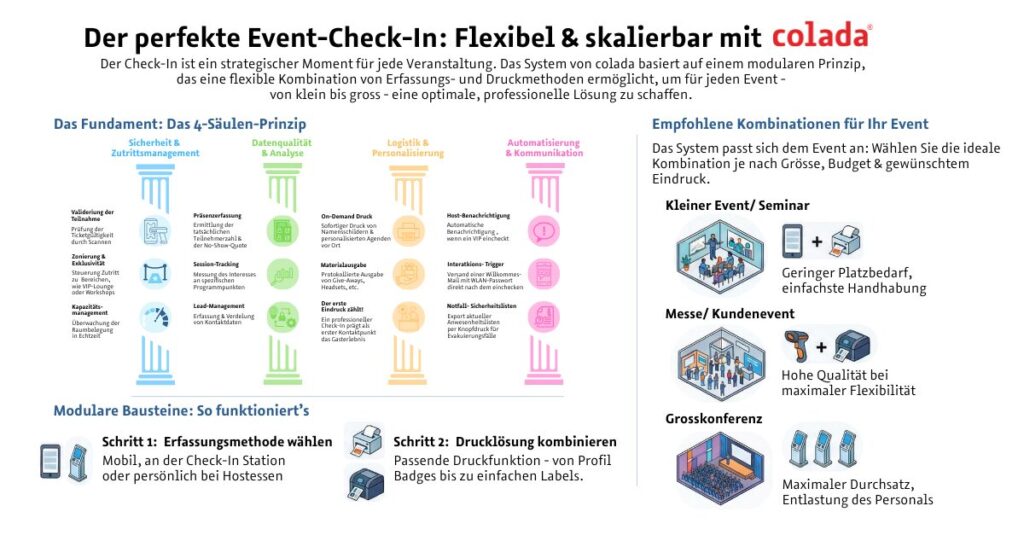
Part 1: The foundation – The 4 pillars of check-in
Before we talk about hardware, we need to define the goals. At colada, every check-in fulfills four core functions:
- Security & access management: real-time validation of tickets, control of VIP zones and monitoring of room capacities (fire protection).
- Data quality & analytics: Measurement of no-show rates, tracking of session visits and structured lead capture for exhibitors.
- Logistics & guest experience: Personalization on site (e.g. badge printing) and minimization of waiting times for a perfect first impression.
- Automation & communication: Immediate notification of hosts upon VIP arrival and automatic sending of digital information (WLAN, app links) during the scan.
Part 2: Recording – flexible on any end device
The way in which guests are recorded depends on the type of event and the desired pace. colada offers three approaches here:
- Mobile scan: Use of any mobile devices (smartphones/tablets). Ideal for flexible admission checks, workshop tracking or lead capture.
- Check-in stations (kiosk): Automated stations with integrated scanners and printers. Perfect for high-traffic events where many guests need to be processed in the shortest possible time.
- Manual check-in: The digital guest list for discreet VIP events or exclusive evening events where the focus is on a personal “welcome” without a ticket scan.
Part 3: Production – Professional printing on site
The colada.cloudprint technology eliminates the complexity of the hardware connection. Each capture variant can be combined with any type of printer:
- Dedicated badge printers: For fast, high-quality and durable name badges in your corporate design.
- Label printer: The efficient solution for stickers that are applied to existing ID cards or pre-printed cards.
- Standard laser printer: Cost-effective production of folded paper badges for plastic bags.
The advantage: planners can decide which print product should be produced on site, depending on the number of guests and budget, without having to change the software configuration.
Part 4: Combinations & scalability
The system adapts to the event, not the other way around. The operating logic for the planners always remains identical:
| Event type | Recommended combination | Benefit |
|---|---|---|
| Small event / seminar | Mobile device + label printer | Small space requirement, easy handling. |
| Trade fair / customer event | Mobile scan + professional bath printer | High quality with maximum flexibility at the stand. |
| Major conference | Kiosk stations (self-check-in) | Maximum throughput, relief for staff. |
Part 5: Full service or DIY – you decide
A technical system is only as good as its implementation. colada supports planners as intensively as the project requires:
- All-round carefree service: colada takes care of all the logistics, from the initial planning and badge design to the installation of the hardware and personal on-site support.
- Hybrid model: Many users use colada completely independently (“DIY”) for the majority of their events. For complex flagship events, they book expert support on a selective basis.
- Planning security: As the work interface in the colada cloud does not change, the learning curve is flat – regardless of whether you are managing a small meeting or a global congress.
Conclusion: scale individually with colada !
Check-in with colada is not an isolated technical procedure, but a modular process. By separating registration and production while maintaining the same column strategy, planners have the freedom to scale each event individually – without having to familiarize themselves with new systems every time.