
Why your next corporate event needs a structured invitation process – and how to guarantee you have the right guests in the room.
Do you know this scenario? Your marketing team is planning a top-class event. The budget has been approved, the location has been booked and the catering will be excellent. But a few weeks before the date, the big trembling begins: Who is actually coming?
In many companies, guest management resembles a “black box”. Sales employees send Excel lists by email, names are added on demand, important stakeholders are forgotten and, in the end, no one knows whether the strategically relevant decision-makers will actually be in the room.
The result: stress for the event team, frustration for the sales team and, in the worst case, empty chairs and a missed return on investment (ROI).
As a decision-maker, you know that an event is not an end in itself. It is a strategic tool for customer loyalty and lead generation. But this tool only works if the guest nomination process is not left to chance.
We will show you a structured approach that puts an end to the chaos and leads your event to success: The Strategic Event Nomination Circle.
The strategic benefit
Before we dive into the process, here’s the “why” and why colada: A digitized, structured nomination process is not an administrative detail, but a real business lever.
It guarantees you:
- Maximum ROI: Only the strategically “right” guests are invited.
- Full capacity utilization: Agile move-up lists help you avoid expensive “no-shows”.
- Budget security: The management retains full control over the number of participants and quality.
- Transparency instead of gut feeling: real-time data shows which sales area is successfully activating its customers.
- CRM integration: Full integration with the CRM quickly brings the ROI to light.
The 5-step plan for successful guest management
What does this process look like in practice? Based on our experience, we have developed a cycle that seamlessly integrates all relevant stakeholders, from marketing to sales to management.
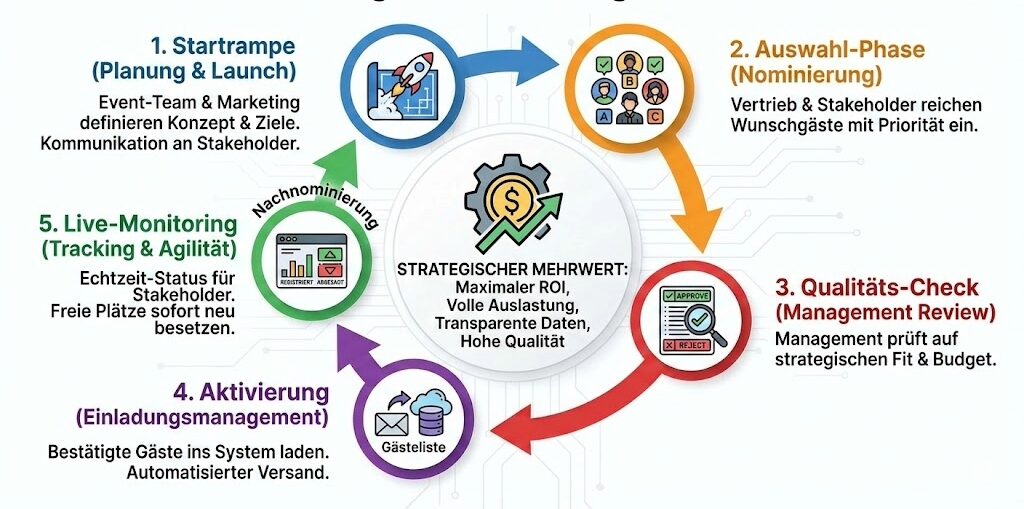
1. the launch pad: planning & launch
- What happens: The event team not only defines the “when and where”, but above all the “why and who”. The goals and the target group are clearly defined.
- The advantage for decision-makers: there is no misunderstanding about what kind of guests are wanted for this specific event. Communication to all internal stakeholders is transparent and consistent.
2 The selection phase: Decentralized nomination
- What happens: Instead of sending Excel lists back and forth, sales, key account management and other stakeholders use a central tool to nominate their preferred guests. Important: They prioritize their guests (e.g. A, B, C customers).
- The decision-maker advantage: you use the decentralized knowledge of your organization. The local sales representative knows best which customer is currently “hot”. Prioritization is crucial for subsequent activities.
3. the quality check: management review
- What happens: This is the strategic gatekeeper. Before an invitation goes out, the management (e.g. regional manager or executive board) checks the consolidated list. Guests are confirmed (“Approved”) or rejected (“Rejected”) if they do not fit the strategic focus or exceed the budget.
- The advantage for decision-makers: absolute control. You ensure that no “deadbeats” are invited and that the event budget is used efficiently.
4 Activation: Professional invitation management
- What happens: The final, adjusted list is now available in the participant management system (colada.guests). Personalized, high-quality invitations can be sent out directly.
- The advantage for decision-makers: a professional external image that reflects the quality of your company. Error-prone manual mailings are a thing of the past.
5. live monitoring & agility (the game changer)
- What happens: This is the most important step for optimal utilization: All stakeholders see the status of their guests in real time: Who has registered? Who has canceled? Who has not yet responded – where do you need to follow up?
- The highlight: If an A-guest cancels, a free place is created. Another guest from the waiting list can now be nominated at lightning speed using the defined process.
- The advantage for decision-makers: agility instead of rigidity. They react to the inevitable rejections and thus guarantee a “full house” with relevant contacts. Sales remain motivated because they can see directly whether their customers are coming.
Conclusion: Strategy needs the right tools – colada
Mapping this “nomination circle” manually with emails and tables is theoretically possible, but practically doomed to failure. The complexity and susceptibility to errors are too high.
To implement this strategic process efficiently, securely and transparently, you need an experienced partner and the right technology.
This is where colada comes into play.
We understand event management not just as software provision, but as a strategic process. Our solutions are designed to map precisely this workflow:
- Central platform: We replace the Excel chaos with a single source of truth.
- Stakeholder portals: We offer intuitive interfaces for sales for nomination and dashboards for management for review.
- Automated agility: Our systems master the logic of waiting lists and move-up procedures to ensure your capacity utilization.
If you don’t want to leave your next event to chance, but want to use it as a measurable strategic tool, we should talk…
Make your guest management a matter for the boss!