
In today’s digital landscape, seamless collaboration between event management and CRM applications is not just a “nice-to-have”, but a fundamental success factor. Events, whether virtual, hybrid or physical, are powerful touchpoints that provide valuable data about the engagement and interests of your customers. Without a bridge to customer relationship management (CRM), this data remains isolated and its true impact is lost.
The basic idea: data-centric collaboration
The combination of event management and CRM solutions is based on a simple but profound idea: the transfer of a person’s “event behavior” to their central customer profile in the CRM.
What really interests CRM
Your CRM is the central database of the truth about your customers and prospects. It wants to map a person’s entire history and behavior in order to optimize sales, marketing and service. What it needs from the event management solution is primarily the “event behavior”:
- Identification: Is the person already known in the CRM? (Matching via e-mail, name, etc.)
- Registration data: When did the person register for which event?
- Participation status: Did the person actually participate(no-show or attendance)?
- Engagement: Which sessions, workshops or stands was the person interested in (e.g. through app use or scan data)?
- New contacts: People who register for an event and do not yet exist in the CRM must be created as new leads.
The integration with HubSpot demonstrates impressively: once the automation workflows are clearly defined, we quickly deliver measurable results. The CRM takes control of this process. It creates/defines the event via the colada API, adds the guests to be invited and triggers the personalized invitation.
During the event or trade fair visit, the data flows back in the other direction: The data enriched and qualified by colada flows automatically back into HubSpot, where it immediately starts the sales workflows.
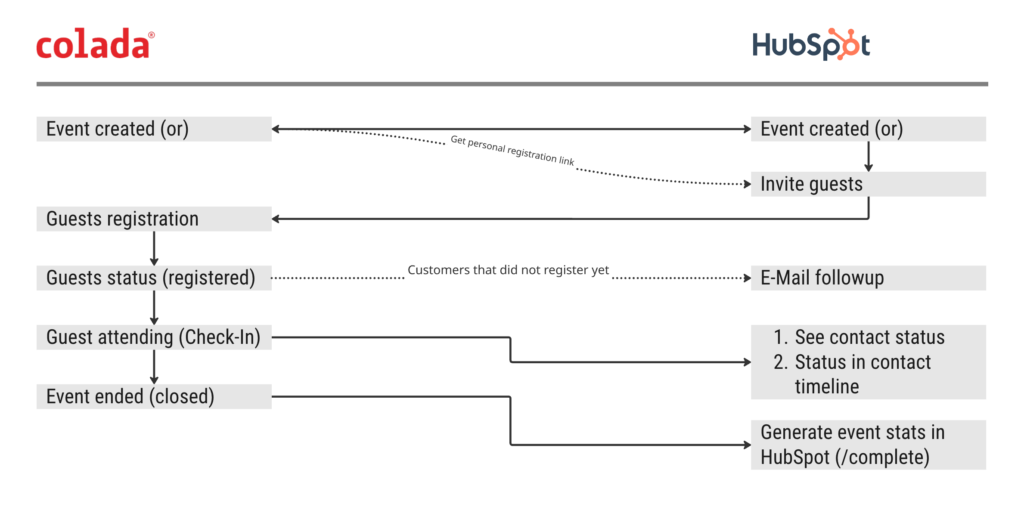
The advantage: a 360° view of the customer
This data exchange enriches the customer data record in the CRM. A sales employee not only sees that “Mr. Müller” is a lead, but also that he has participated in the last three
- Personalization: More targeted marketing campaigns (“Since you are interested in our webinars…”).
- Qualification: Better evaluation and prioritization of leads (an active event participant is a hotter lead).
- Sales readiness: More informed sales talks, as the sales team knows the customer’s specific interests.
The colada advantage: integration in the DNA
Many event solutions require complex, often error-prone and expensive interface solutions to communicate with a CRM. colada takes a consistently different approach here: the ability to integrate is anchored in the application from the ground up.
1. born for connectivity
colada is designed to be integration-agnostic by nature. This means:
- It is not a “black box” that only spits out data laboriously. It can communicate with other systems as required via its integrations.
- Whether Salesforce, Microsoft Dynamics, HubSpot or another system – colada offers the necessary mechanisms to connect smoothly.
2. focus on the business process
The biggest advantage lies in user expertise. colada knows how important it is that its own employees not only set up the integrations technically, but also understand, support and adapt them to the client’s requirements.
- Understanding: Your employees not only know the event processes, but also the business requirements(What is a qualified lead? What data does the sales department really need?)
- Implementation and support: Instead of having to rely on external consultants who only have a superficial knowledge of the systems, colada employees and partners can define the data flows together with you and provide long-term support. This ensures that the data quality remains high and the integration delivers real added value.
An event is more than just a one-off meeting;
It’s a data goldmine. Systems like colada, which have integration and data exchange in their